Search Wildlife

≡
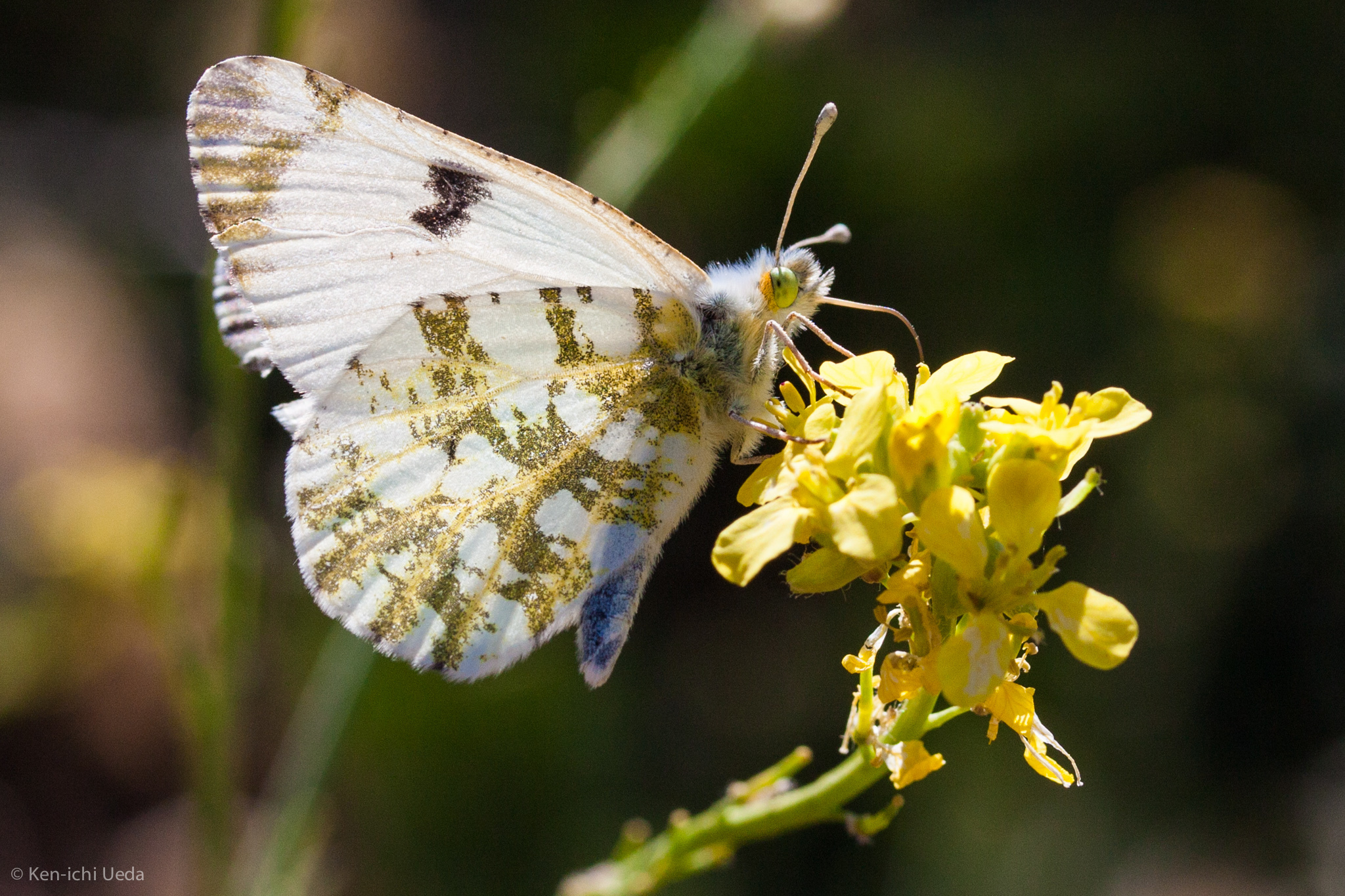
Large Marble Butterfly
Euchloe ausonides
NatureServe conservation status
Global (G-rank): G4?
State (S-rank): S2
External links
Phenology
This species overwinters as a pupa and emerges as an adult in late March and early June in hotter regions, or from May to early July in the northern portions of its range and at higher elevations (Xerces Society, 2022). Low elevations may allow for two broods to emerge (Brock & Kaufman, 2003). Adult lifespans have not been measured across all subspecies, but if consistent across subspecies is approximately 5-9 days (Lambert, 2011; Xerces Society, 2022). During this time adults lay eggs which hatch in approximately 4-5 days; larvae develop rapidly through five instars and pupate in just over two weeks (Xerces Society, 2022). Adults fly during the day, and rest in grasses or woody shrubs overnight (Scott, 2020).
Species range
This species is historically widespread throughout Western North America, from California north through Canada into Alaska, and east to Colorado and New Mexico (Brock & Kaufman, 2003). It is absent in Arizona. It was once considered common in the summer throughout much of its western range; However, long-term monitoring throughout the butterfly’s range has suggested the species has a ¿ chance of extirpation at all monitored sites in the next 50 years (Forister et al., 2023). Since 2013, this once common butterfly has been observed less frequently in over 75% of its range (Burls et al., 2023). Unfortunately, few datasets exist that have monitored E. ausonides abundance over time; however, it is estimated that abundance in the in the western grasslands that make up the core of this species range is likely tied to the species overall abundance (Burls et al., 2023; Xerces Society, 2022).
Utah contains two subspecies of this butterfly, E. ausonides transmontana, which is present in western Utah, and E. ausonides coloradensis, which is present in eastern and central Utah, where it is still abundant (Xerces Society, 2022).
Habitat
The main habitat requirement for this species is the presence of Brassicaceae host plants upon which to feed and lay eggs. They are often found in open areas and woodlands in foothills, as well as streamsides, desert washes, canyons, sagebrush steppe, grasslands, and montane slopes (Scott, 2020; Xerces Society, 2022). Brassicaceae host plants prefer disturbed soils that allow for seed germination, examples of which may include rodent burrows, treefalls, erosion from ephemeral streams, or anthropogenic disturbances including agricultural activities (Xerces Society, 2022). There is some evidence to suggest that E. ausonides prefers less disturbed areas for pupating; this would mean a mix of disturbance regimes is necessary to support E. ausonides at all life stages (Burls et al., 2023).
Food habits
Adults can be seen taking nectar from flowers during the summer months when they are active; they visit flowers of many colors, but adults may prefer yellow or white flowers (Burls et al., 2023). Many host plants are weedy and dispersed, which in turn encourages adult dispersal; adults average 400 m of travel per day (Scott, 2020). Eggs are laid on host plants in the family Brassicaceae, the flowers and fruits of which are the main food source for larvae. Known plant associations include Cardaria draba, Descurainia pinnata, Achillea millefolium, Alcea rosea, Arnica cordifolia, Cerastium arvense ssp. strictum, Cirsium arvense, Dichelostemma capitatum ssp. capitatum, Draba stenoloba, Erodium cicutarium, Erysimum capitatum, Eschscholzia californica, Heterotheca villosa, Mertensia lanceolata, Packera fendleri, Physaria montana, Plantago lanceolata, Potentilla pulcherrima, Punus americana, Ranunculus sp., Raphanus sativus, Rubus sp., Sencio crassulus, Senecio integerrimus, Sisyrinchium bellum, Taraxacum officinale, Thlaspi arvense, Townsendia hookeri, Trifolium pratense, Turritia glabra, and Wyethia helenioides (RICP, n.d.).
Threats or limiting factors
The large range of this species means it faces a myriad of threats and conservation challenges. Urban development poses a threat, as heavily fragmented landscapes isolate populations of the butterfly; this is exacerbated by the strong preference of the butterfly for host plants in the family Brassicaceae, as suitable habitat patches may be more isolated than for generalist species (Burls et al., 2023). Population fragmentation reduces the ability of E. ausonides to disperse across the landscape, and makes it more difficult to maintain genetic diversity as population size is reduced. Urban development is a particular threat to the two subspecies present in Utah, in the area surrounding Salt Lake City, as this is a rapidly growing urban center (Burls et al., 2023). Development outside of urban areas is also an issue, as it destroys high quality habitat and brings increased OHV recreation, wildfires, and infiltration by invasive plant species. Agricultural expansion is also a concern in central and Northern Utah, threatening the open habitats and food resources this species relies upon.
Overgrazing is a prevalent issue in the range of E. ausonides transmontana and coloradensis. Across the west, including in Utah where the butterfly occurs, much of the rangeland has been degraded by grazing rates above the Appropriate Management Levels set by the BLM, with particularly extreme impacts to riparian areas that may play host to these butterflies (Burls et al., 2023; Kaweck et al., 2018). Overgrazing is an issue because it destroys larval and adult food sources, and potentially destroys pupal overwintering sites (Black et al., 2011; Burls et al., 2023). Overgrazing has been linked to the extirpation of certain subspecies in other parts of this species range, including in British Columbia and Washington (Burls et al., 2023). Overgrazing also erodes fragile soils and increases sedimentation in streams; overgrazing effects such as these have been observed in Utah’s High Uinta Wilderness where E. ausonides is known to occur (Burls et al., 2023).
Besides habitat degradation, the modification of natural systems is a pervasive and extreme threat to this species in the state of Utah. More intense and longer lasting fires are problematic to this species; increased fire frequency and intensity is associated with increased mortality in every life stage of E. ausonides (Burls et al., 2023). Increased fire frequency also negatively impacts the host plants of this butterfly: annual Brassicaceae do not rapidly repopulate burned areas, which potentially leaves E. ausonides lacking food sources needed to develop. Brassicaceae are also often removed as pest plants or noxious weeds, further modifying the habitats that E. ausonides requires to survive and maintain its population. This can be particularly problematic when the butterfly is in its larval stage, as plant removal directly results in caterpillar mortality.
Climate change is also a major conservation concern to E. ausonides across its entire range. Recent research has tied declines in abundance of this species to warming temperatures during the fall season (Forister et al., 2021). Generally speaking, the increasing temperatures, increasing drought, lower snowpack, and increased pest pressure brought on by climate change have been shown to negatively impact butterfly populations; montane species are particularly vulnerable to increased temperature and prolonged drought (Xerces Society, 2022).
In addition to the factors listed above, the introduction of non-native plant species, pollution including pesticides and herbicides, and parasitism by non-native parasitic wasps are all threats facing E. ausonides in the state of Utah (Barth & Irvin, 2023). The large number of challenges to the conservation of this species, as well as its disappearance across much of its range, indicate a clear need for further monitoring and protection. As of 2023, this species has been petitioned for listing as “Threatened” under the Endangered Species Act. Its inclusion as a Utah SGCN in the 2025 State Wildlife Action Plan also acknowledges the challenges facing this species. Hopefully, these efforts will lead to actions that prevent further declines of this species in the state of Utah, and lead to recovery across the species range.