Utah Species Field Guide | Utah Natural Heritage Program
Utah Species Field Guide Utah Species Field Guide
Glenwood Milkvetch (Astragalus loanus)

(Tap or click to view all images.)

Photo by Tony Frates; Ava Brinkley; Ava Brinkley
Sources: ESRI, USGS, NOAA

Glenwood Milkvetch

Glenwood Milkvetch (Astragalus loanus)

Photo by Tony Frates; Ava Brinkley; Ava Brinkley
Sources: ESRI, USGS, NOAA

Astragalus loanus

NatureServe conservation status

Global (G-rank): G1
State (S-rank): S1

External links

Phenology

This species flowers between May and early June. 

Diagnostic characteristics

Astragalus calycosus var. calycosus is another tiny milkvetch found in the Sevier Valley, Utah and elsewhere. Astragalus loanus and Astragalus calycosus var. calycosus can be positively identified by their flowers and leaves as follows:

Astragalus loanus has flowers that are white with a purple keel tip and in racemes of just 2-7 flowers per raceme.  The leaflets are ovate or rhomboid and densely hairy with hairs that do not give the plant a green appearance and not a silvery, grey appearance.

Astragalus calycosus var. calycosus has flowers that can be variously white, pink, purple, or blue but the keel tip remains maculate white in all variations otherwise and the flowers are either in short, loose, 1-8 flowered racemes or more openly with 7-17 flowers per inflorescence. The leaflets are obovate to elliptic and densely hair with silvery, grey hairs giving the plant a silvery, grey appearance. 

Species range

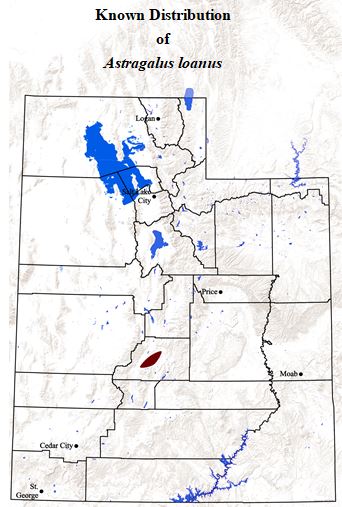
A Southern Plateaus endemic, found in Sevier County, Utah.

Threats or limiting factors

Threats are unknown.

Species search

Species search


Multicellular organisms that are autotrophic or make complex carbohydrates from basic constituents. Most use photosynthesis.

Flowering plants that produce seeds enclosed in an ovary

Multicellular organisms that develop from the fertilization of an egg by a sperm. Heterotrophic - obtain food by ingestion.

Have skulls and backbones.

Cold blooded, lay eggs on land

Have feathers and lay eggs

Invertebrates with an exoskeleton, jointed appendages, and segmented bodies

Animals having 3 pair of legs, 3 body sections, generally 1 or 2 pair of wings, 1 pair of antennae.

Soft bodied animals with an internal or external shell and a toothed tongue or radula. Have a mantle that lines and secretes the shell and a muscular foot that allows for movement.

Two hinged lateral shells and a wedged shaped "foot". Bivalves lack tentacles and a head.


Lee Kay and Cache Valley Shooting Centers
» Shooting centers
Wildlife Blog: Views from DWR employees
» Wildlife Blog
Report poachers — 1-800-662-3337
» Report poachers
Wildlife dates
» Important dates
Hunter, angler mobile app
Hunter Education: Sign up for classes
» Hunter education
The Natural Resources Map & Bookstore: discover hands-on resources
» DNR Map & Bookstore