
The DNR Division of Law Enforcement was formally established in January 2025 to unify law enforcement from four Utah Department of Natural Resources divisions: Wildlife Resources; State Parks; Outdoor Recreation; and Forestry, Fire and State Lands. Visit the Utah Department of Natural Resources website for more information about DNR law enforcement.
Report poaching and other wildlife-related crimes

Help us protect your wildlife, turn in a suspected wildlife violation
If you witness an in-progress wildlife or fishing violation — or you're aware of a previously committed wildlife crime — please contact DNR conservation officers as soon as possible.
Note: If you are witnessing a public safety emergency, please call 911.
Contact UTiP to report a wildlife crime
Your four Utah Turn-in-a-Poacher (UTiP) contact options are listed below in order of urgency:
Text 847411 to alert us with any information you can about the violation. Tips can be directed to the appropriate DWR region by adding the following keywords to the body of the text message:
- Central Region: UTIPCRO
- Northern Region: UTIPNRO
- Southern Region: UTIPSRO
- Northeastern Region: UTIPNERO
- Southeastern Region: UTIPSERO
Note: Please include the desired keyword in your text, or the respective office won't receive it.
Call the Utah Turn-in-a-Poacher hotline at 800-662-3337. It's staffed 24 hours a day, 365 days a year. Hotline operators will ask you detailed questions about what you saw, and in many instances, may patch you directly through to a local conservation officer.
If the violation may not demand an immediate response, or if you're unwilling or unable to speak with UTiP hotline operators, you may submit a tip through the DNR Law Enforcement app, which is available as a free download for iOS (Apple) and Android devices. This reporting option will initiate a chat conversation with DNR Law Enforcement personnel. You may remain anonymous, if you wish, but we encourage you to provide your name and contact information to better assist the investigating officers.


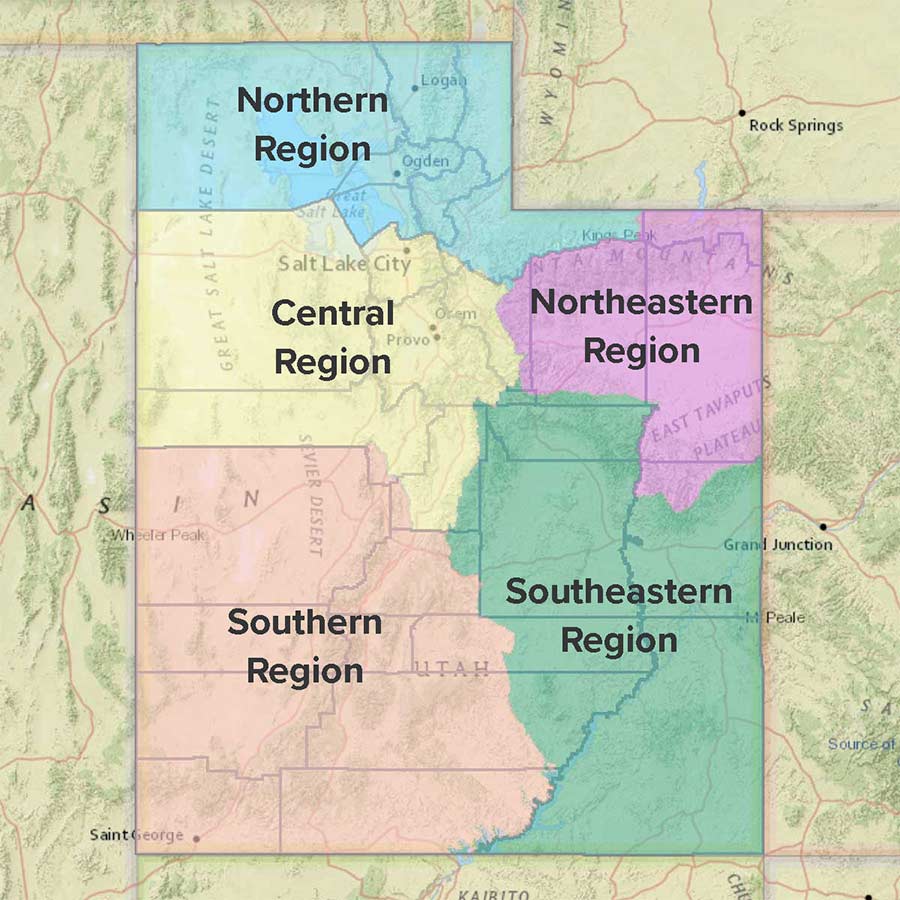
You may also submit an online tip using the map here. If you choose this reporting option, please understand that system limitations may make it difficult for our officers to contact you with any follow-up questions. Please provide detailed, comprehensive information in the body of your report — or be sure to include your name and contact information — to ensure that investigating officers can obtain the details they need.
- Central Region Office
- Northern Region Office
- Southern Region Office
- Southeastern Region Office
- Northeastern Region Office
Reporting wildlife crimes makes a difference
The long-term viability of Utah's wildlife depends on citizens who care passionately about natural resource issues and support law enforcement efforts.
You may also earn a reward for your efforts. Do your part to protect Utah's wildlife by reporting poachers immediately.
Be a good witness
Do not attempt to stop a wildlife violation yourself. Get the information that DNR law enforcement officers need. Before you report a violation, try to get as much of the following information as you can. The more information we have, the better job we can do.
- What happened: Knowing the date, time, location and number of shots will help us investigate.
- The suspect: Tell us about the suspect(s) and provide a physical description. For example, the suspect's approximate age, height, hair color, clothing and other identifiable characteristics will help us locate the suspect(s).
- Weapons: Was there a weapon involved? Was it a rifle, a shotgun or archery equipment? Were there shots fired?
- Vehicle: Was the suspect using a vehicle? A license plate number is extremely helpful! What kind was it — a truck, car, SUV, ATV? What color was it? The make and model of the vehicle is also very useful.
- Witnesses: Were there witnesses? Who are they? Having their names and contact information will help.
- Evidence: Is there physical evidence? If so, don't disturb it. Obtain GPS coordinates or mark the area, but do not move anything or touch anything.
Call our hotline at 800-662-3337 or send an online report that contains as much of the above information as possible. Delays might result in lost evidence or allow the poacher to get away.
Know the consequences
Because Utahns value wildlife so highly, convicted poachers face steep consequences. In addition to paying fines and restitution, poachers may also face jail time, the confiscation of hunting equipment and the loss of hunting and fishing privileges in multiple states.
Fines and restitution
When someone is convicted of illegally killing or possessing protected wildlife, they often must make restitution payments. These payments go into the Help Stop Poaching Fund, which pays rewards to hunters who help catch and convict poachers. To learn more, see Utah Code §§ 23A-5-309 and 23A-5-311.
License suspension across the country
When DNR Law Enforcement determines that a poacher's crime is intentional or reckless, that person may lose the right to hunt and fish in Utah and many other states. Utah is a member of the Interstate Wildlife Violator Compact, which is an agreement among U.S. states to honor each others' decisions to deny licenses and permits to poachers.
Learn more
- How to become a DNR conservation officer
- General feedback or questions? Contact the DNR Division of Law Enforcement at
This email address is being protected from spambots. You need JavaScript enabled to view it. .