
Education
Definitions, fun facts and learning activities
There is much more to the Great Salt Lake than salt, shrimp and birds. Over the last century and a half, this inland sea has been among the most popular and luxurious travel destinations in the United States, with many prestigious spas and resorts. Here you can learn more about the lake, its famously invigorating water and the surrounding area.
Definitions
carotenoid: A plant defense chemical that builds up in organisms.
diapause: A period of time where an organism's metabolism or development is slowed down in order to withstand harsh conditions (think of extreme hibernation).
halophile: A "salt-loving" organism that thrives in high salt concentrations. Many of the bacteria and algae species in the Great Salt Lake are halophiles.
hemolymph: The body fluid of brine shrimp (and other "open system" crustaceans).
hyperosmotic (synonym: hypertonic): A solution that has a higher salt concentration compared to its surroundings.
hyposmotic (synonym: hypotonic): A solution that has a lower salt concentration compared to its surroundings.
hemoglobin: A molecule within the body fluid that binds oxygen and carries it to specific places within the body.
naupliius: The first free-swimming stage of life for a brine shrimp. They either hatch from cysts or from eggs inside the mother's uterus (plural: nauplii).
osmoregulation: The maintenance of a constant electrolyte equilibrium within an organism by controlling the levels of salts in the circulatory system.
ovoviparous: Live birth. In brine shrimp, eggs hatch within the uterus into nauplii (this is also known as "viviparous" — they mean the same thing).
oviparous: Birth of eggs that hatch outside of the body. In brine shrimp, these would be as hard cysts, which remain through the winter and hatch as temperatures rise in the spring.
phytoplankton: Single-celled algae, which use photosynthesis to grow in aquatic environments. They are the main food source for brine shrimp, and their presence and distribution dictates much of the shrimp's life history and development.
parthenogenetic: Asexual reproduction where the parent produces a diploid offspring without fertilization.
salinity: The amount of salt dissolved in a body of water, often represented as a percent. For example, the Great Salt Lake's salinity ranges from 8-17%.
zygogenetic: Sexual reproduction through the combination of male and female sex cells (i.e., sperm + egg = zygote).
Fun facts
- The Great Salt Lake is the eighth largest terminal lake in the world.
- In 1987, a Chilean flamingo escaped from Tracy Aviary in Salt Lake City, made his way to the Great Salt Lake, and has likely lived there ever since. Named "Pink Floyd," he was last spotted in 2005.
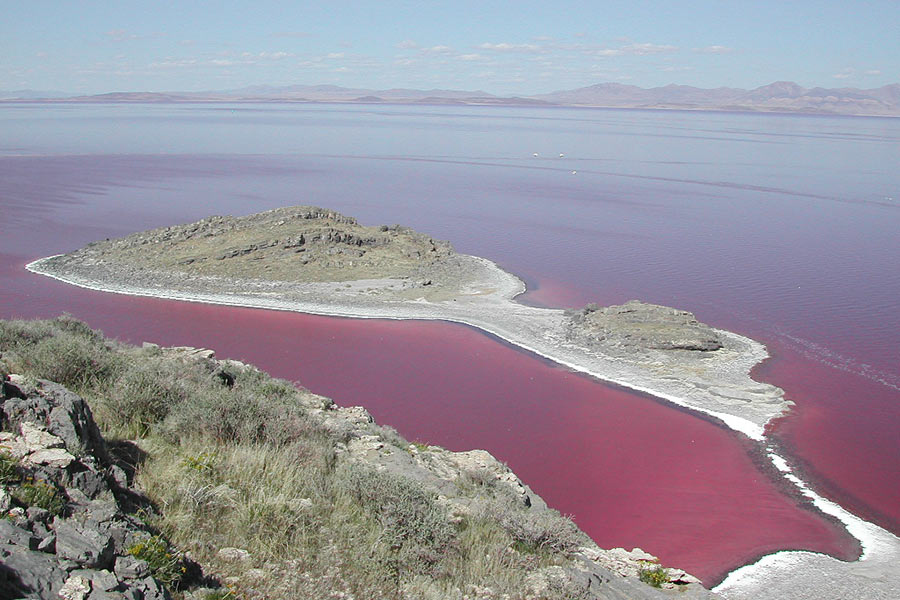
- The North Arm of the Great Salt Lake is so salty that only two known types of bacteria can live in it — halobacterium and halococcus, which are extreme salt-lovers (halophiles). There are from 1,000,000 to 100,000,000 bacteria per milliliter in the North Arm, and these bacteria have the unique pigment that gives the water its purple or red hue.
- Swimming in the lake is popular, as the water is considered highly curative. Some companies have even sold bottled lakewater to drink for good health.
- There are dozens of freshwater streams on Antelope Island.
- You can hike, bike, ride horses, swim, hunt, birdwatch and boat on and around the Great Salt Lake.
- You probably eat salt from the lake every day! One of Morton Salt's biggest plants is near Salt Lake City.
- Brine shrimp, at a certain life stage, are used as feed for table shrimp. So, the next time you order a shrimp cocktail, you just might be eating brine shrimp from the lake, too!
- The lake's South Arm is three to five times saltier than the ocean. The North Arm is nearly ten times saltier.
- The Great Salt Lake boasts some of the world's largest populations of birds! The area is a regionally, nationally and hemispherically important ecosystem for migratory birds.
- No fish can survive in the North or South arms of the lake. The largest aquatic animals in the lake are brine shrimp and brine fly larvae! There are larger invertebrates and some fish in the Farmington and Bear River Bays.
- Brine fly larvae have been known to reach numbers of 370 million per mile of shoreline in the summer. Luckily, they don't bite! (If you do get bitten out there, it's more likely the gnats or no-see-ums.)
- The first North American transcontinental railroad was finished at Promontory Summit, just north of the lake, in 1869. The actual spot where the final, golden spike was laid is now the Golden Spike National Historic Site. Thirty-five years later, a more direct route was built that cut through the lake and crossed Promontory Point, located on the southern tip of the Promontory Mountain peninsula.
- Lake Bonneville, the Great Salt Lake's predecessor over 12,000 years ago, was up to 1,000 feet deep and covered about one quarter of the state of Utah, as well as parts of Idaho and Nevada.
- Up to five million eared grebes (50-99% of the species' entire population) have been known to visit the lake at one time!
- The lake is home to one of the largest breeding colonies of American white pelicans in the world. They breed in large numbers on Gunnison Island.
- The Great Salt Lake contributes 5-8% of Utah's snowpack from its "lake effect."
Learning activities
Download the following resources:
Create your own brine shrimp ecosphere
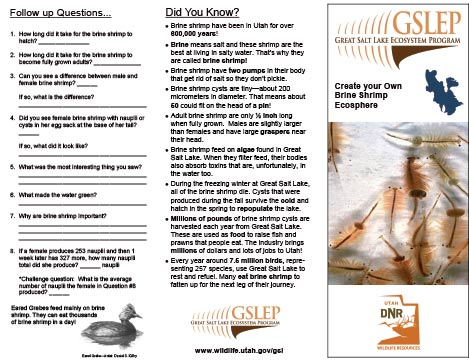
This brochure contains instructions on how you can create your own brine shrimp ecosphere, and watch them hatch and grow. Also included are fun facts and activities for kids to learn about these fascinating creatures.
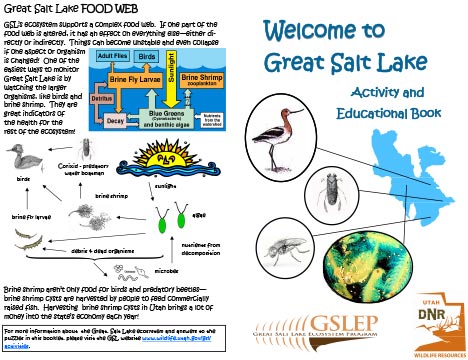
Welcome to the Great Salt Lake: Activity and Educational Booklet
Story and design by Hilary Whitcomb
This 12-page, PDF booklet provides kids with activities and information about Great Salt Lake history, geography, and ecology. It includes a wordsearch, a maze, a crossword puzzle, a fun story about the adventures of Andy Avoceti and cool facts about brine shrimp, birds and the food web.
The booklet version is designed to fit on three double-sided, 8.5" × 11" pages. Each page of the PDF is double-sided; just make sure your printer can print on both sides and that the page orientation is set to "landscape." You may also need to set page scaling to "fit to printable area." Or, if you prefer, you can download the consecutive-page version, which places a single-sided page on each 8.5" × 11" page.
Download the consecutive page version – PDF (1.9 MB)
Answer key and bibliography
This key contains the answers for the crossword puzzle and wordsearch in the Welcome to Great Salt Lake: Activity and Educational Booklet. The key also lists the references used for the booklet's bird facts.
Download the answer key – PDF (152.81 KB)