
Wildlife diseases in Utah
Like people, animals are subject to a wide variety of ailments
Wildlife, domestic animals and humans share a large and increasing number of infectious diseases. The continuing globalization of society, increasing human populations and associated landscape changes will further enhance interfaces between wildlife, domestic animals and humans, thereby facilitating additional infectious disease emergence.
Wildlife species are subject to diseases resulting from exposure to microbes, parasites, toxins and other biological and physical agents. These wildlife diseases are often highly visible and result in large-scale mortality. Such losses are incompatible with healthy, vigorous wildlife populations — making research into, and development of, practical methods for wildlife disease diagnosis and mitigation of wildlife losses a critical component of effective wildlife management.
What the DWR is doing

The DWR has a wildlife disease program in place to (1) monitor and control diseases of concern, such as chronic wasting disease, whirling disease, West Nile virus and avian influenza; (2) investigate sick or dead wildlife reported by wildlife authorities and the public; (3) assess the effects of disease in Utah's wildlife populations; (4) reduce or eliminate diseases that threaten the health and vitality of Utah's wildlife, or that pose a human health risk.
Learn more about the following diseases found in wildlife:
Tumors and abscesses

- Details
Virus-caused tumors (e.g., warts, fibroma, papilloma) are commonly found in deer, and occasionally elk, moose, and antelope. Abscesses are firm lumps filled with white or green pus that are found within an animal's tissue.
West Nile virus

- Details
West Nile virus is primarily transmitted by mosquitoes of the Culex family during normal bloodfeeding. In most cases, it produces few or no symptoms. However, in some cases, West Nile viral infection may cause more severe symptoms including encephalitis, or swelling of the brain, which can be fatal. Persons over the age of 50 may be at an increased risk of more severe forms of West Nile virus infection.
Whirling disease

- Details
Whirling disease is a condition affecting trout and salmon caused by a microscopic parasite known as Myxobolus cerebralis. If sufficiently infected, young fish may develop symptoms such as whirling behavior, a black tail or even death.
White-nose syndrome

- Details
White-nose syndrome is a disease that affects hibernating bats. The disease is caused by the cold-loving fungus Pseudogymnoascus destructans, which invades the skin of hibernating bats, causing tissue damage.
Yellow grubs
- Details
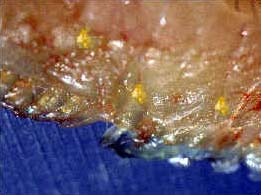
The yellowish cysts in the muscle of some fish caught at Pelican Lake and a few other waters in Utah. They are the intermediate stage of a trematode parasite called Clinostomum complanatum, more commonly known as "yellow grub."