
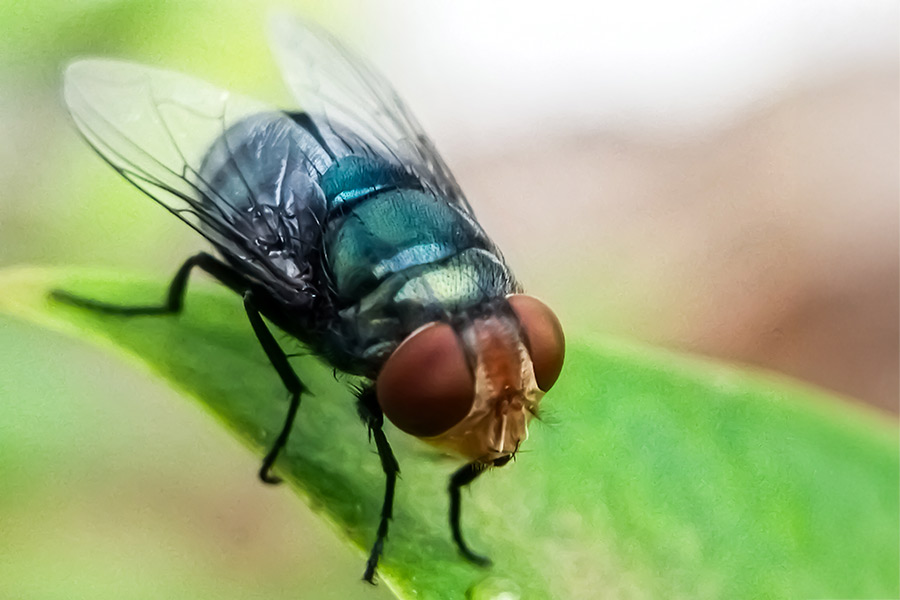
The U.S. Department of Agriculture has detected New World screwworm in the United States. Although it has not yet been identified in Utah, it poses a serious threat to wildlife and domestic animals. For current status updates, visit the USDA website.
New World screwworm (Cochliomyia hominivorax) is a parasitic fly whose larvae (also called maggots) feed on the living tissue of warm-blooded animals. New World screwworm larvae can infest open wounds and mucous membranes of living animals, which can lead to serious infections and, if untreated, death.
Although it was eradicated from North America in 1968, New World screwworm has recently reappeared in Texas and New Mexico. Infestations pose serious risks to wildlife, livestock, pets and in rare cases, human health. The USDA, Utah Department of Agriculture and Food, Utah Department of Health and Human Services, DWR and other agencies are actively working to monitor and contain this threat.
Threats to wildlife
The impact of New World screwworm on wildlife and domestic animal health can be severe. Deer and many other species are vulnerable to screwworm infestations, which can cause death for adult animals and reduce the number of young that survive and grow to maturity.
Affected wildlife species
- Deer, elk, moose and other hoofed mammals
- Rabbits and hares
- Racoons, squirrels and other small mammals
- Turkeys and birds (more uncommon)
Once New World screwworm is present, it can take extensive resources and time to eradicate it. To prevent its spread in Utah, early identification and response is vital. Hunters and outdoor enthusiasts can help in the detection and effective mitigation of this parasite by reporting any signs of New World screwworm. Please follow the instructions below to report suspected cases.
How to identify and report New World screwworm
New World screwworm larvae feed on living tissue, so if you see larvae (maggots) on live or very recently dead animals, please report it.


Right: New World screwworm larvae (maggots) are pale in color, tapered on both ends and have encircling lines of dark spines.
Images courtesy of the USDA
More tips for identifying New World screwworm (warning, graphic images):
Contact your closest DWR office if you suspect a case of New World screwworm
When you report a suspected case of New World screwworm, please provide your contact information, case location (or the location of the harvested animal, GPS coordinates preferred), and share any photographs of the larvae, wounds and any flies, if present. A biologist will investigate the report, take additional photographs and determine if samples need to be collected.
Hunters and outdoor enthusiasts
New World screwworm only affects live animals. Contact your closest DWR office to report a live animal (that you've witnessed in person or on trail camera footage) or recently harvested animal if there are signs of New World screwworm such as:
- A wound or mucous membranes filled with maggots
- Unusual behavior (head shaking, lethargy or isolation)
If you suspect a harvested animal has New World screwworm present:
- Do not move the carcass, and do not process or consume the meat.
- Wear gloves when handling the animal and wash your hands afterward.
- Take pictures and record a GPS point or nearest location.
- Immediately contact your closest DWR office.
Nasal bots are common in the upper airways of healthy deer; please do not confuse nasal bots with New World screwworm larvae. (See UDAF guidance for differentiating botflies and screwworm.)
Taxidermists and meat processors
Report any recently harvested animal with wounds filled with maggots. Wounds will often be deep, with thickened tissue and a foul smell. Nasal bots are common in the upper airways of healthy cervids; please do not confuse nasal bots with New World screwworm larvae. (See UDAF guidance for differentiating botflies and screwworm.)
- Take pictures and record any harvest location information.
- Report to your closest DWR regional office.
- Collect maggots in ethanol or 70% isopropyl alcohol.
- Do not place live maggots directly into trash; kill all maggots in ethanol or 70% isopropyl alcohol, and save ~10 for testing in ethanol.
- Bag and freeze the carcass.
- Wear gloves when handling the animal and wash your hands afterward.
Wildlife rehabilitators
New World screwworm is a mandatory reportable disease in the United States. If you suspect a case in wildlife, including mammals and birds, call a DWR regional office to report it. (Please include the primary point of contact's phone number, location of capture and species.) We will request pictures of the wound and maggots to determine if it needs to be sampled.
Look for:
- Maggot infested wounds on live animals with a foul smell
- Live tissue with deep cavernous wounds
- Vertically buried maggots
- White egg masses around wounds
Treatment:
- Remove all eggs/maggots from the wound with forceps.
- Place maggots in ethanol or 70% isopropyl alcohol.
- Do not place live maggots directly into trash; kill all maggots in ethanol or 70% isopropyl alcohol first, and save ~10 for testing in ethanol.
- Treat wounds and do not release the animal until wounds are healed.
- Freeze animal's bedding to kill maggots.
- Educate staff on identifying New World screwworm.
See UDAF guidance for differentiating botflies and screwworm.
Domestic animals (livestock and pets)
New World screwworm only affects live animals. If you suspect a live or recently deceased animal is infested with New World screwworm:
- Take photos of larvae, the wound and any flies, if present.
- Be prepared to provide history, owner contact information and pictures.
- Contact the Utah State Veterinarian's office at 801-982-2235 or complete the NWS Suspect Report Form (for domestic animal cases only).
- Based upon the history and clinical signs, the State Veterinarian and USDA Area Veterinarian in Charge will determine if the larvae warrant submission to USDA.
Learn more
- USDA Stop Screwworm: screwworm.gov
- USDA: The facts about New World screwworm (common myths and misconceptions)
- USDA: Confirmed detections dashboard
- USDA: New World screwworm prevention and treatment
- CDC: About New World screwworm
- UDAF: New World screwworm
- UDAF: How to identify New World screwworm
- UDAF: Myiasis — Differentiating screwworm from botflies
- UDAF: Reporting suspected New World screwworm (in Utah domestic animals only)
- UDHHS: New World screwworm (for public health and healthcare providers)
- Texas Parks and Wildlife: New World screwworm
Frequently asked questions
See more information from the USDA regarding common myths and misconceptions about New World screwworm.
A: Not at this time. The DWR is partnering with UDAF and USDA to actively monitor and prepare for potential introduction in Utah.
A: No, there are species of fly larvae (maggots) that only feed on dead tissue. New World screwworm larvae only feed on live tissue.
A: The USDA and partners have increased surveillance in and around the infestation zones where it is currently being found. Each animal case is reported and treated. Sterile flies are being released at the northernmost boundaries of the infestation zone to interrupt the pest's reproduction cycle and prevent spread farther into the country.